In a nutshell
- 🌱 Overfeeding raises salts and osmotic stress, causing root burn, wilting, and nutrient lockout as pH and ion balance skew.
- 🔎 Spot symptoms early: dark clawed leaves (nitrogen toxicity), tip scorch, interveinal chlorosis, stalled growth, and white salt crusts; verify with EC and pH checks.
- 🦠 Excess feed harms the soil microbiome, suppressing mycorrhizae, collapsing structure, reducing infiltration, and driving nutrient runoff that fuels algal blooms.
- 🧪 Feed smarter: start at half-strength, alternate feed and water, target 10–20% runoff, monitor EC/pH, and flush to reset after mistakes.
- 🎯 Tailor to context: match fertiliser to substrate (e.g., add Ca/Mg for coco), time feeds to active growth, and start low, adjust slowly for resilient plants.
Gardeners are generous by nature. A little extra feed here, a booster there, the promise of lush growth hovering in the bag of fertiliser like a whisper of summer. Yet plants are not bottomless vessels for nutrients; they run on balances, not excess. When we overfeed, we alter chemistry as well as biology, forcing roots and soil microbes to adapt to conditions they never asked for. Leaves may green up briefly, then stall. Flowers drop. Pots crust with salts. The uncomfortable truth is simple: too much of a good thing quickly becomes bad horticulture. Understanding why overfeeding harms your plants is the first step to feeding them better, and growing with confidence.
The Hidden Chemistry of Excess Nutrients
Fertilisers are salts. Add too many, and you raise the solution’s electrical conductivity (EC), increasing osmotic pressure around roots. Water moves from lower to higher solute concentrations; stress the gradient and roots lose water rather than absorb it. The result is paradoxical: you water and feed more, yet the plant wilts. Tip scorch follows. More fertiliser never equals guaranteed faster growth; it often equals osmotic stress and root burn. Beyond water relations, chemistry gets trickier. High potassium can antagonise magnesium and calcium uptake, while surplus ammonium can acidify the rhizosphere and depress root respiration.
pH drift compounds the problem. In alkaline media, iron and manganese become less available; in acidic conditions, phosphorus binds with aluminium and iron, forming insoluble compounds. This is called nutrient lockout, not deficiency—there’s plenty present, it’s just inaccessible. Plants shout in symptoms we mistake for hunger, prompting yet more feed. That feedback loop is costly. Excess fertiliser reshuffles the nutrient deck, turning abundance into imbalance. The plant is forced to spend energy re-regulating ions, a metabolic tax that slows growth and invites disease.
Recognising the Telltale Symptoms
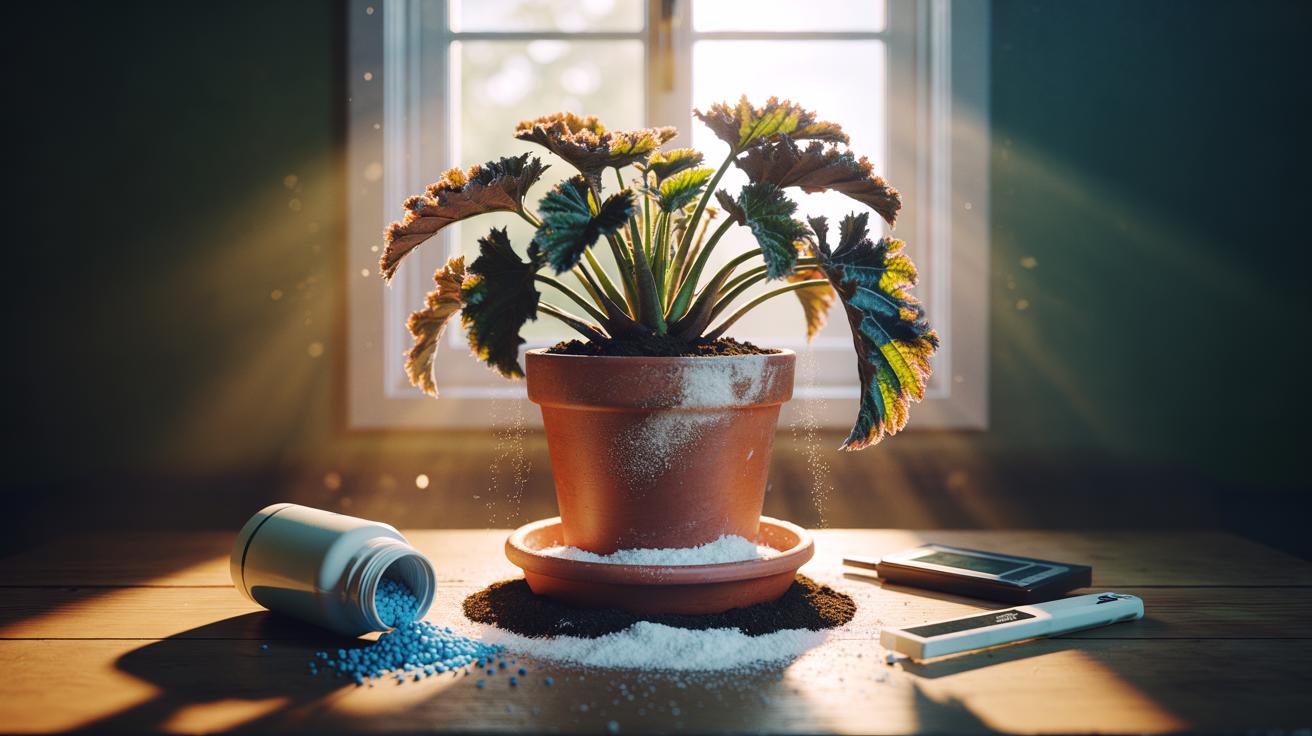
Overfeeding rarely announces itself in a single dramatic gesture; it creeps. Look closely. Dark, overly glossy foliage with downward “clawing” often signals nitrogen toxicity. Crisp brown tips with a pale halo hint at salt burn. Interveinal yellowing on older leaves may indicate magnesium lockout caused by high potassium. Leaves that feel brittle and snap easily can reflect calcium disruption. Stunted internodes, aborted buds, and a distinct white crust at the pot rim are all classic clues. If multiple deficiencies appear at once after a heavy feed, think lockout before you think scarcity.
| Symptom | Probable Cause | Quick Check |
|---|---|---|
| Leaf tip burn, yellow halo | Salt build-up | Run-off EC noticeably higher than input |
| Dark green, clawed leaves | Excess nitrogen | Back off feed; watch for rapid soft growth |
| Interveinal chlorosis on older leaves | Mg lockout from high K | Check pH; consider Epsom salts foliar |
| Stalled growth, multiple “deficiencies” | pH drift/lockout | Measure media pH; flush and reset |
Houseplants in small pots are especially vulnerable, as limited substrate amplifies any feeding error. Seedlings and recently repotted specimens, with tender root tips, also suffer quickly. Outdoors, heavy rain can briefly mask overfeeding by leaching, but the damage often reappears as nutrients reconcentrate during dry spells. Diagnosis is detective work; track your inputs, test your run-off, and confirm with pH before reaching for the bottle again.
Soil Health and the Microbial Balance
Healthy plants depend on a thriving soil microbiome. Overfeeding, especially with high-salt synthetic fertilisers, suppresses mycorrhizal fungi and beneficial bacteria that trade minerals for plant sugars. When microbes withdraw, the soil’s enzyme activity falls and nutrient cycling stalls, so you become ever more reliant on the next feed. Excess nutrients don’t just stress roots; they rewrite the social contract in the rhizosphere. In clays, sodium and certain salts disperse aggregates, collapsing structure and smearing pore spaces. Water infiltration drops. Roots linger in soggy, oxygen-poor pockets ripe for rot.
There’s a physical cost too. Salts raise soil solution concentration, shrinking the protective water film around particles. Earthworms avoid it. Aggregates crumble. Over time, this undermines cation exchange capacity (CEC) efficiency and weakens the soil’s buffering ability. Run-off carries dissolved nutrients into drains and streams, fuelling algal blooms and depleting oxygen for aquatic life. This is not abstract: UK catchments already grapple with nutrient pollution. Your pot, bed, and border connect to a larger watershed—responsible feeding is part of responsible gardening. By respecting soil life, you create resilience that fertiliser alone can’t buy.
Feeding Smarter: Practical Dosage Strategies
Start with the label, then cut it. Most plants thrive at half-strength feeds applied on a schedule shaped by light, warmth, and growth phase. In winter, feed sparingly. For houseplants, aim for an input EC of 0.5–1.2 mS/cm; fruiting crops like tomatoes often sit at 1.8–2.5 mS/cm under high light. Measure your tap water’s baseline; hard UK water can begin at 0.4 mS/cm before you add nutrients. Use a simple EC pen and a reliable pH meter, and log readings. Test, don’t guess. Alternate “feed” and “plain water” days, targeting 10–20% run-off to prevent salt accumulation in containers.
Choose products that match your substrate. Coco coir often needs extra calcium and magnesium; peat-free mixes can have variable buffering. Consider slow-release fertilisers for steady nutrition, backed by light liquid feeds during peak growth. If symptoms appear after a heavy hand, flush the pot with three times its volume in pH-balanced water, then resume at quarter-strength. Outdoors, time feeding to active growth and soil warmth; cold roots can’t process nutrients efficiently. Finally, calibrate to your microclimate: brighter windows, longer days, and warm conservatories drive demand; shady halls do not. Feed the plant in front of you, not the one on the packet.
Plants flourish on sufficiency, not excess. By understanding osmotic stress, lockout, and the quiet needs of soil life, you can swap blunt-force feeding for tuned care that saves money, reduces waste, and yields sturdier growth. The rule of thumb is plain: start low, watch closely, adjust slowly. Precision, not generosity, is the gardener’s ally. With a meter, a notebook, and a lighter hand, your results will improve week by week. What one change will you make this season to move from overfeeding to optimised feeding?
Did you like it?4.5/5 (28)