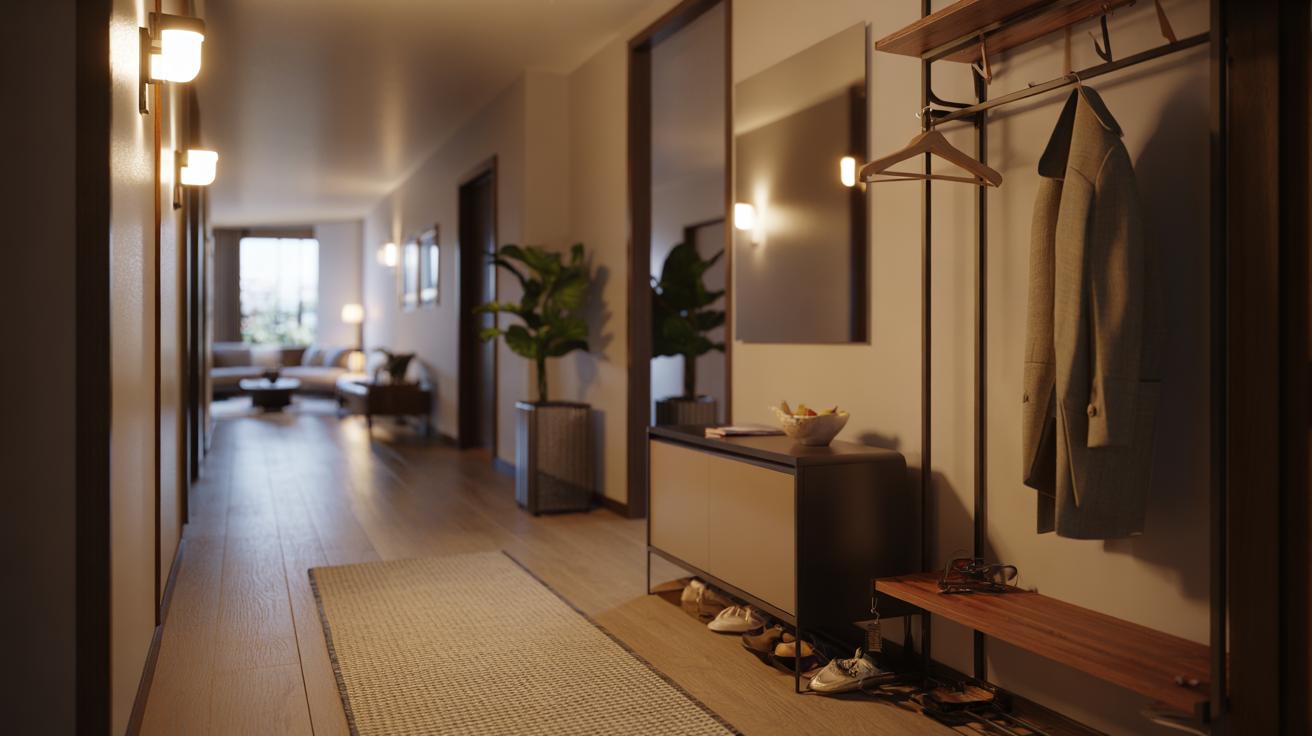
In a nutshell
- 🧠 A tidy hallway triggers the primacy effect, lowering cognitive load at the home’s threshold so your brain reads rooms as larger within seconds.
- 👀 Design reduces visual noise: protect clear sightlines along the floor, use high light reflectance colours, align verticals, and place mirrors to bounce natural light for depth.
- 🧭 Order at the door becomes a keystone habit: a defined drop zone and simple rules curb “clutter creep,” while balancing prospect-and-refuge calms the nervous system and enlarges perceived space.
- 🛠️ Daily tactics: install a hip-height drop zone, use closed shoe storage, keep a consistent coat rail, add a narrow runner and warm 2700–3000K lighting, then finish with a one-song reset—because constraints create clarity.
- ✨ The payoff is immediate: reduced stress, clearer focus, and amplified spatial calm that makes every adjoining room feel bigger through enhanced perceived space.
A hallway is the first conversation your home has with your mind. Step through the door and your brain scans for order, light, and safe passage. Psychologists argue that this micro-judgement, made in under a second, sets your mood and biases every room you enter next. When the entrance is clear, the whole interior seems to breathe; when it’s crowded, rooms feel smaller even if their dimensions haven’t changed. What looks like square footage is often a story your senses are telling you. Create a calmer story and space instantly expands. Here is why a tidy hallway reliably delivers that effect—and how to achieve it.
The Psychology of Thresholds: Why Hallways Set the Tone
Psychologists talk about the primacy effect: first impressions frame everything that follows. Your hallway is the home’s primacy engine. It’s a threshold that flips the brain from outside alertness to inside ease. If the threshold is clogged with shoes, parcels, and errant coats, your mind reads “obstacles” and elevates cognitive load. That load steals bandwidth you’d otherwise allocate to appreciating space, light, and calm. Your brain decides “spacious or cramped” within seconds of crossing the door.
Another mental mechanism at play is Gestalt grouping. The mind prefers coherent patterns. A tidy hallway groups elements into legible categories—one place for keys, one line for shoes, one sightline down the corridor. Clutter shatters those groups into noisy fragments. When nothing belongs anywhere, everything feels everywhere. Perceived chaos shrinks perceived space.
Safety cues matter too. Clear sightlines suggest wayfinding and control. A well-lit, obstacle-free run to the living area reads as permission to relax. The result: muscles soften, breath slows, and rooms seem wider because your nervous system is no longer braced for collision. Spatial calm starts at the threshold.
Visual Noise, Light, and Lines: How Design Tricks the Brain
Clutter is visual noise. It increases the number of edges, colours, and shapes your eyes must parse, which compresses perceived openness. Reduce noise and you instantly extend the corridor. Prioritise a continuous floor sightline; the more uninterrupted your flooring appears, the longer and wider the space reads. Low-profile shoe storage that sits off the ground creates a floating shadow line, making the skirting and floor look broader. When the floor is visible, the room feels possible.
Light compounds the illusion. Use pale, low-chroma colours with high light reflectance to push walls outward. One statement piece—an artwork, a textured runner—can anchor attention without reintroducing chaos. Align verticals: hooks in a straight rail, frames hung in a level grid. The brain reads order as space because predictable lines demand less processing power. Mirrors help, but place them to bounce natural light down the corridor; random mirror scatter breeds glare, not volume.
Think in layers: base (walls and floor), mid-zone (storage and hats), and high zone (lighting). Keep the base serene, control the mid-zone with closed or uniform containers, and use the high zone for warm, directional light. Consistent cues reduce decision fatigue and expand perceived depth.
| Quick Action | Psychological Effect | Spatial Payoff |
|---|---|---|
| Clear 1 metre of floor | Lower cognitive load | Longer sightline, wider feel |
| Designate a drop zone | Habit cue and containment | Stops clutter creep |
| Neutral base colour | Less visual noise | Walls recede |
| Mirror opposite light | Brightness amplification | Depth illusion |
Behavioural Domino Effect: A Tidy Hallway Changes How You Live
Space isn’t just geometry; it’s behaviour. A neat entrance is a keystone habit. Put a tray for keys, a bowl for post, and a rail for coats within one arm’s reach of the door and you shrink the “friction cost” of tidiness to almost nothing. When the first 30 seconds at home are effortless, the rest of the evening follows suit. The psychological reward is immediate: you’ve completed a mini-task, so your brain gets a small hit of achievement before you’ve even taken off your shoes.
Clutter attracts clutter. That’s the “magnet effect” social psychologists note in shared spaces. Break it at the door and you stop the migration of bags to sofas and paperwork to dining tables. Family dynamics change, too. Clear rules—two pairs of shoes per person; one coat out at a time—create a social norm visible at a glance. Norms outperform nagging because they’re environmental, not personal.
There’s also the prospect-and-refuge balance. We like to see ahead (prospect) while feeling protected (refuge). A tidy hall offers prospect—an open view down the home—while a bench nook or slim console provides refuge. Together they calm the nervous system, making every adjoining room feel airier than it measures.
Practical Steps: A Five-Minute Plan That Works Every Day
Start with ruthless simplicity. Install a single drop zone at hip height by the door—tray, small bowl, and a shallow letter rack. Below, opt for a closed shoe unit sized to your household’s daily use, not its entire wardrobe. Set a hard limit: if a pair doesn’t fit, it returns to bedrooms. Constraints create clarity. Mount a rail at one consistent height; matching hangers remove visual stutter and speed decisions.
Next, chase the floor. Keep 300–500mm of visible skirting where possible, then run a narrow runner rug to draw the eye forward. Use warm 2700–3000K lighting for evening and a brighter bulb at the far end to pull you through. Add one expressive element only: a print, a plant, or a sculptural bowl. Rotate it seasonally to satisfy the itch for novelty without expanding clutter. Finally, end each day with a one-song reset: clear post, reset the tray, rehome shoes. Five minutes, big dividends.
A tidy hallway isn’t interior perfectionism dressed up as advice; it’s a practical way to hack perception, mood, and daily habits. By lowering visual noise and streamlining the moments right after you cross the threshold, you create an elastic sense of space that ripples through the whole home. Small rituals at the door make rooms feel larger before you’ve even turned on the lights. What one change—tray, mirror, rail, or rug—will you implement tonight, and how will you know it made your home feel bigger tomorrow?
Did you like it?4.6/5 (30)